Local Content Intelligence
User manual
Every field name, hint, rule sentence and permission on this page is rendered from the product's own strings, so the manual changes when the product does.
User manual
Every field name, hint, rule sentence and permission on this page is rendered from the product's own strings, so the manual changes when the product does.
1. What the product does
Local Content Intelligence is software for Saudi supplier companies. It calculates your local content score from your own figures, shows you what the official form will say about it, and produces the working paper your auditor asks for.
2. Before you start
Five score-bearing sections cover what the official form asks: labour, goods & services, capacity building, depreciation & amortisation, and CAPEX, revenue & export. In a workspace the guided filing adds a sixth step: the disclosures and Appendix A.
Have the year's audited accounts, payroll totals and supplier spend in front of you. The score appears with the first figure, and a finished scenario becomes the filing pack and the Excel working paper in a workspace.
3. The guided filing, step by step
Work through the LCGPA template sections in order. Your answers save into the current scenario automatically.
3.1 Labour
Enter the yearly compensation of all Saudi employees added together, and all foreign employees added together. Saudi pay counts in full; foreign pay counts at 53.4%. Enter totals only, never an individual's salary.
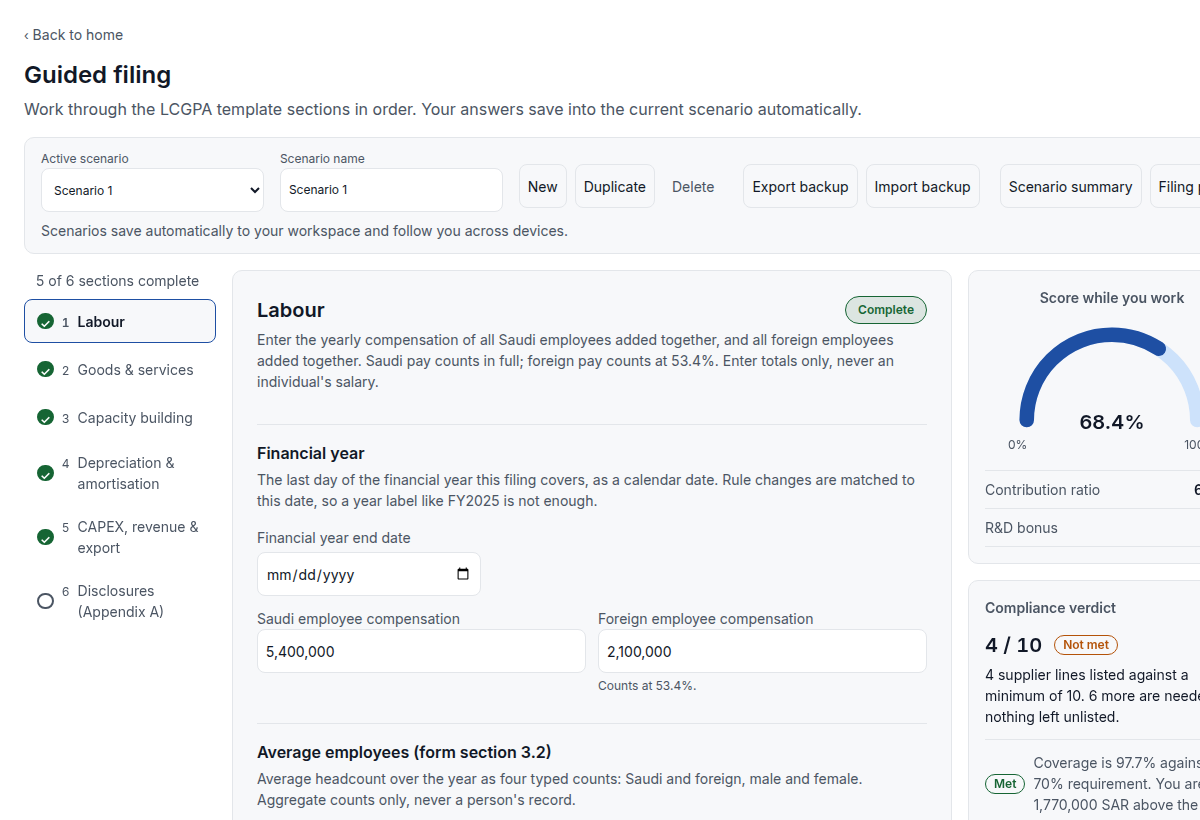
| Field | On the screen | Where the figure comes from |
|---|---|---|
| Saudi employee compensation | The yearly compensation total for Saudi employees, from the payroll ledger. Totals only. | |
| Foreign employee compensation | Counts at 53.4%. | The yearly compensation total for foreign employees, from the payroll ledger. |
| Financial year | The last day of the financial year this filing covers, as a calendar date. Rule changes are matched to this date, so a year label like FY2025 is not enough. | The financial year end, from the audited financial statements. |
| Average employees (form section 3.2) | Average headcount over the year as four typed counts: Saudi and foreign, male and female. Aggregate counts only, never a person's record. | Employee counts at year end, from HR records. Counts, never names. |
3.2 Goods & services
List what you bought and from whom. In supplier detail, add one row per supplier: pick its sector, or enter an audited score if the supplier has one, and type the yearly spend. If you only have totals, switch to direct totals.
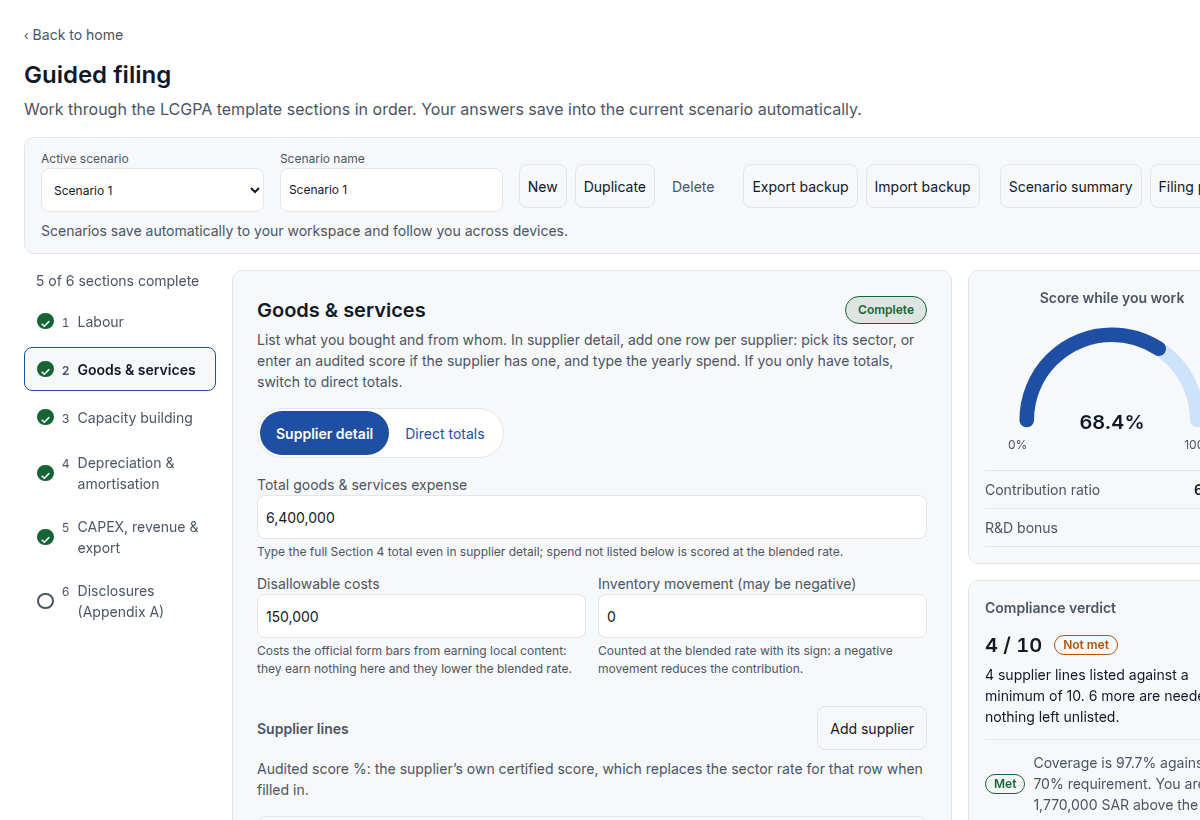
| Field | On the screen | Where the figure comes from |
|---|---|---|
| Total goods & services expense | The year's goods and services expense, from the audited income statement and its notes. | |
| Local content contribution | In direct totals: the local content amount your suppliers' certificates support. | |
| Disallowable costs | Costs the official form bars from earning local content: they earn nothing here and they lower the blended rate. | Costs the template excludes, from the expense notes. |
| Inventory movement (may be negative) | Counted at the blended rate with its sign: a negative movement reduces the contribution. | The inventory movement adjustment, from the audited accounts. |
| Supplier lines | One row per supplier from the purchase ledger: its sector from the sector table, or the supplier's own audited score. |
3.3 Capacity building
Money spent training Saudis, developing KSA suppliers, or on research & development in the Kingdom counts in full. R&D also earns a score bonus, which is full once it reaches 2% of revenue.
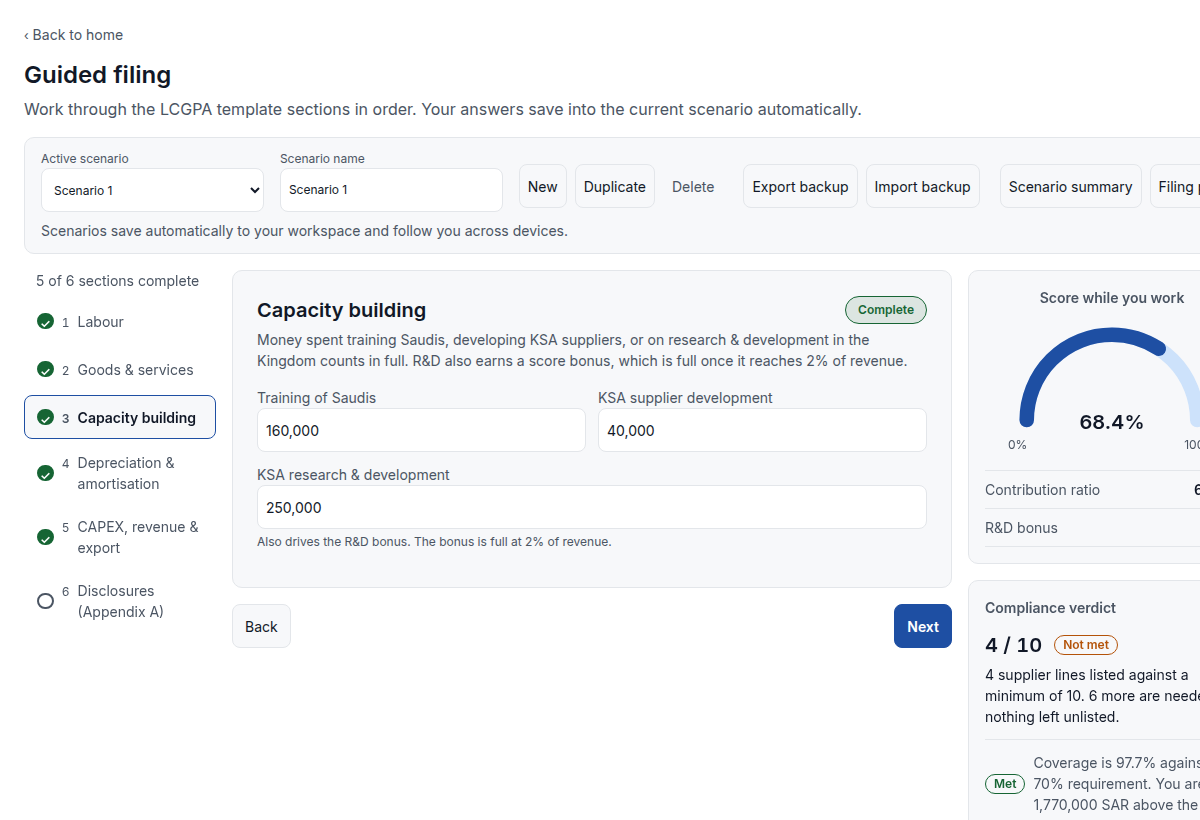
| Field | On the screen | Where the figure comes from |
|---|---|---|
| Training of Saudis | Spending on training Saudi staff, from the training or HR ledger. | |
| KSA supplier development | Spending on developing KSA suppliers. | |
| KSA research & development | Also drives the R&D bonus. The bonus is full at 2% of revenue. | Research and development spending in the Kingdom. |
3.4 Depreciation & amortisation
Enter this year's depreciation and amortisation by asset class: locally sourced assets count in full, foreign assets at 30%. Building and Land Improvements accepts local assets only.
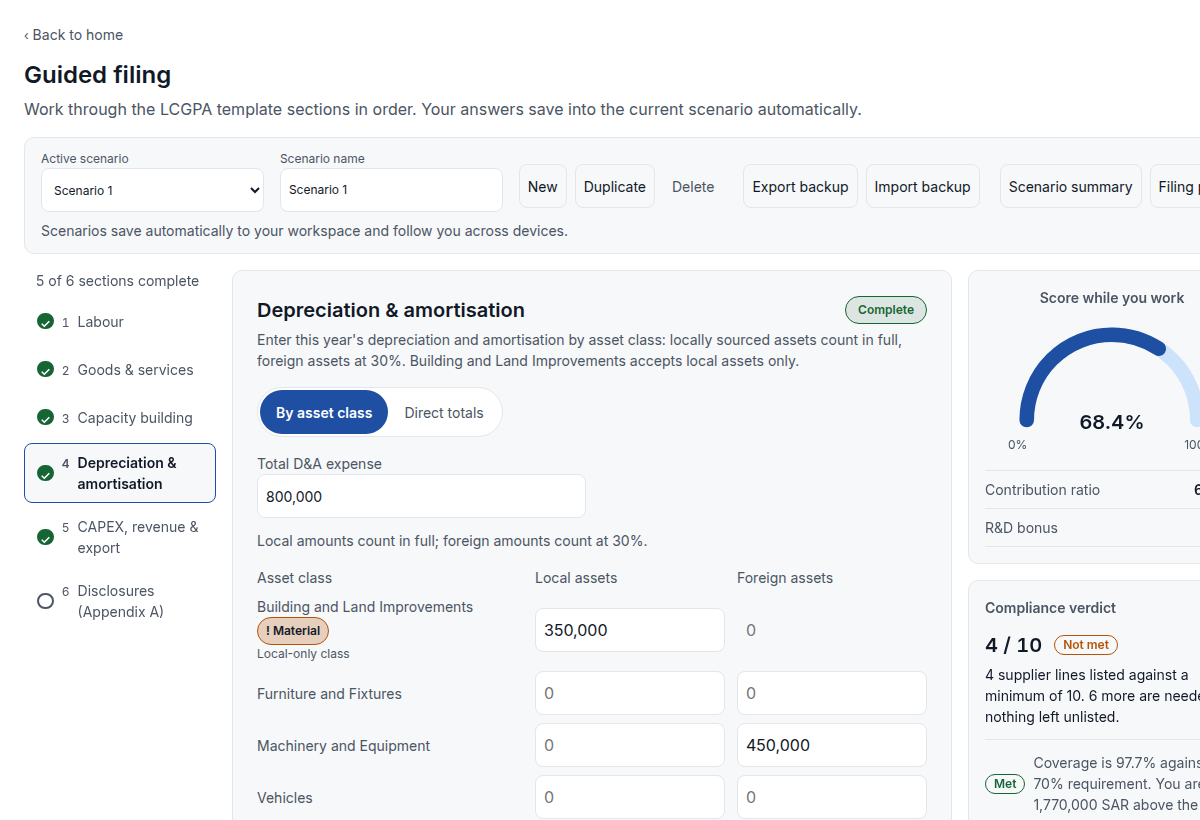
| Field | On the screen | Where the figure comes from |
|---|---|---|
| Total D&A expense | This year's depreciation and amortisation charge, from the fixed asset note. | |
| Local content contribution | Local amounts count in full; foreign amounts count at 30%. | The same charge split by asset class and by where each asset was sourced, from the fixed asset register. |
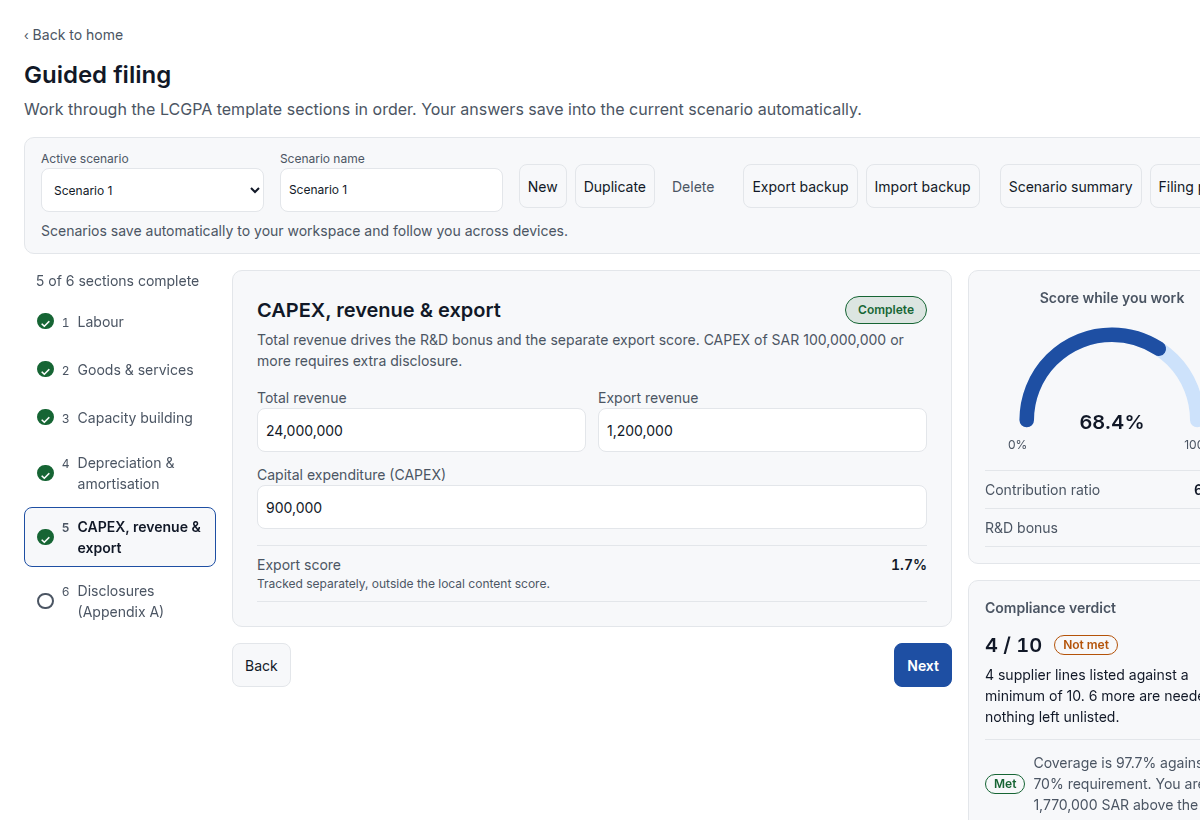
3.5 CAPEX, revenue & export
Total revenue drives the R&D bonus and the separate export score. CAPEX of SAR 100,000,000 or more requires extra disclosure.
| Field | On the screen | Where the figure comes from |
|---|---|---|
| Total revenue | Total revenue, from the audited income statement. | |
| Export revenue | The part of revenue earned on exports, from the revenue note. | |
| Capital expenditure (CAPEX) | The year's capital expenditure, from the cash flow statement or the asset additions note. | |
| CAPEX score | Tracked separately, outside the local content score. | Asset purchases in the year with each seller's audited score certificate, once CAPEX reaches the disclosure level. |
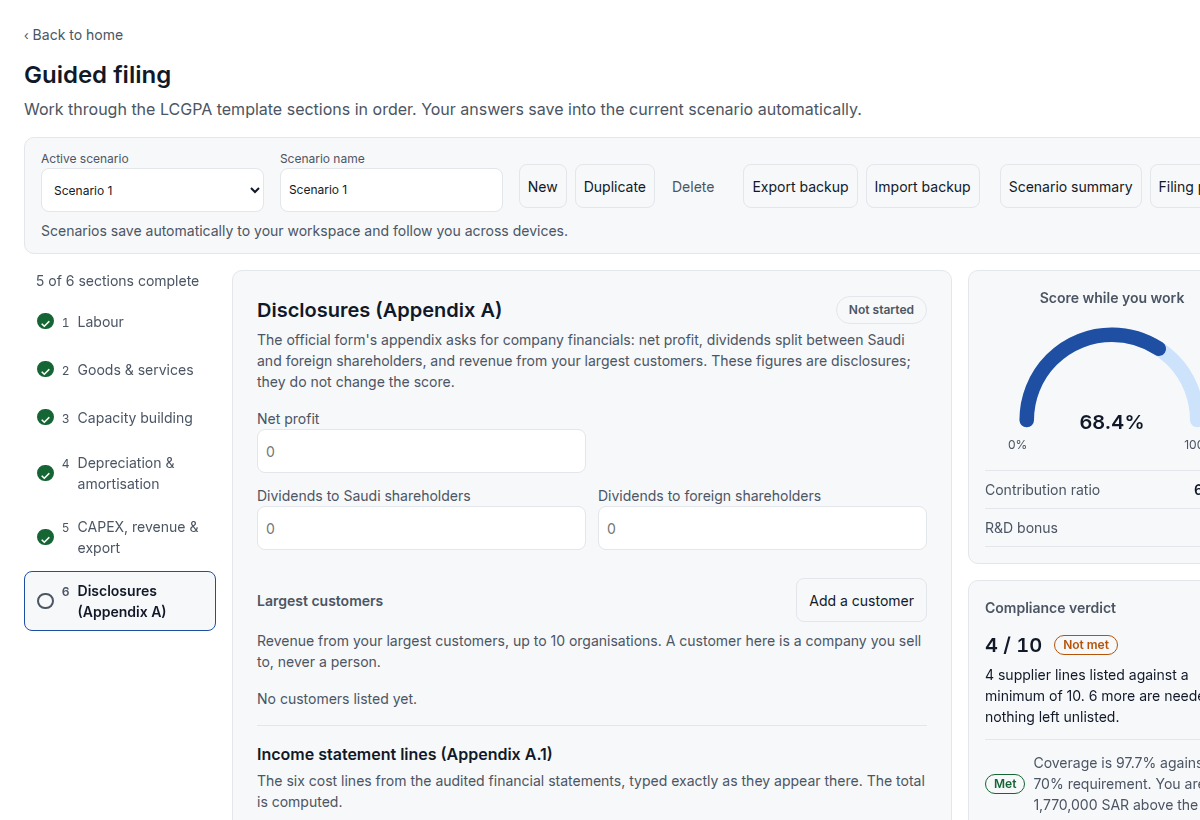
3.6 Disclosures (Appendix A)
The official form's appendix asks for company financials: net profit, dividends split between Saudi and foreign shareholders, and revenue from your largest customers. These figures are disclosures; they do not change the score.
| Field | On the screen | Where the figure comes from |
|---|---|---|
| Net profit | Net profit, from the audited income statement. | |
| Dividends to Saudi shareholders | Dividends split between Saudi and foreign shareholders, from the statement of changes in equity. | |
| Largest customers | Your largest customers and the revenue from each, from the sales ledger. | |
| Income statement lines (Appendix A.1) | The six cost lines from the audited financial statements, typed exactly as they appear there. The total is computed. | The expense lines that reconcile the goods and services total to the audited accounts. |
| Less eliminations (Appendix A.2) | Costs inside total cost that are not Section 4 goods and services spend. Four rows are formulas on the form, so they are drawn from your own figures here and never typed twice. | Cost items the template lists separately: customs duties, provisions, government fees and losses. |
4. The score and the sector table
Enter your compensation totals, supplier spend, depreciation and capacity building, and the score appears as you type. The calculation follows the official Local Content Score Template exactly, including the parts that are easy to get wrong: the blended supplier rate, the treatment of disallowable costs, which depreciation total the relevant cost is taken from.
Local content score · Sector table version: LCGPA-OM-LRG-02-V2
Tracked separately, outside the local content score.
5. The compliance checks
The verdict answers each check with one word and one sentence. The sentences below are the product's own, shown with invented example figures.
Coverage: enough of the goods & services total must be covered by listed suppliers or audited scores.
Coverage is 69% against a 70% requirement. You are 100,000 SAR below the line.
Supplier lines: at least ten lines, unless nothing remains unlisted.
6 supplier lines listed against a minimum of 10. 4 more are needed, or nothing left unlisted.
Goods share: goods must carry their required share of the goods & services total.
Goods are 32% of goods & services against a 25% requirement. You are 350,000 SAR above the line.
Remaining expense: what stays unlisted must sit under the ceiling.
Remaining expense is 1,800,000 SAR against a 500,000,000 SAR ceiling: 498,200,000 SAR of room.
Over-listing: listed lines, disallowable costs and inventory must not exceed the total.
Listed lines, disallowable costs and inventory exceed the goods & services total by 120,000 SAR.
CAPEX disclosure: CAPEX at or above the threshold demands the Section 5.2 table.
CAPEX is 120,000,000 SAR, at or above the 100,000,000 SAR disclosure level: the form demands extra disclosure.
Material lines: supplier lines above 1% of relevant cost should carry audited scores.
2 supplier lines exceed 1% of relevant cost: audited scores are recommended.
Material assets: asset classes whose local depreciation exceeds 1% of relevant cost are counted.
1 asset class has local depreciation exceeding 1% of relevant cost.
6. The four documents
Every scenario can produce these; the purpose sentences are the ones the hand-off step shows.
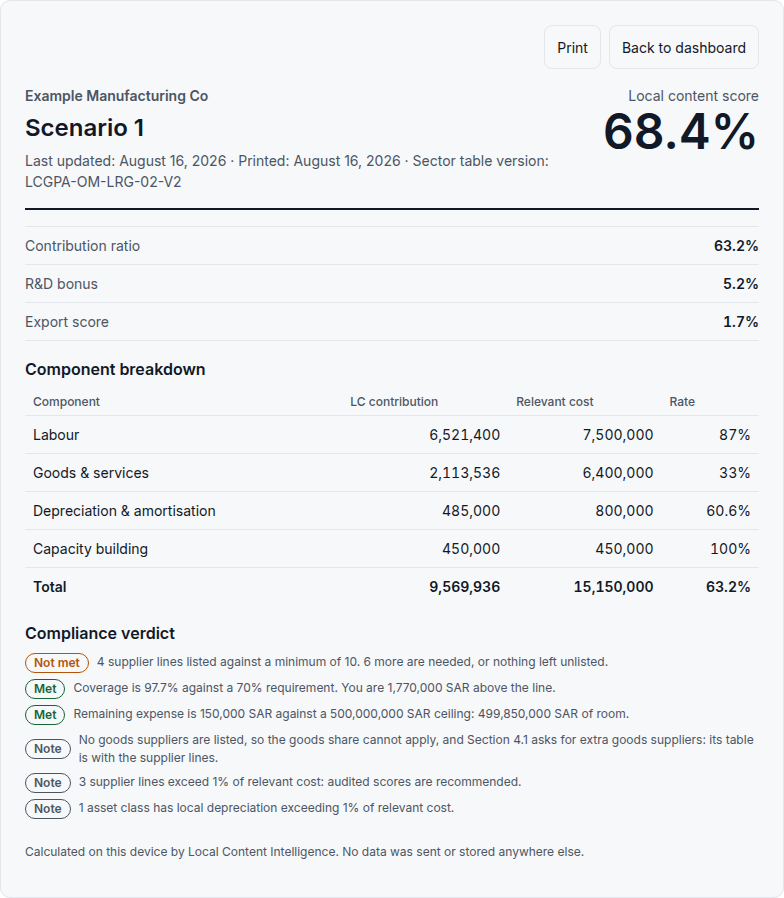
Scenario summary
One page for whoever signs: the score, the compliance verdict and the reconciliation.
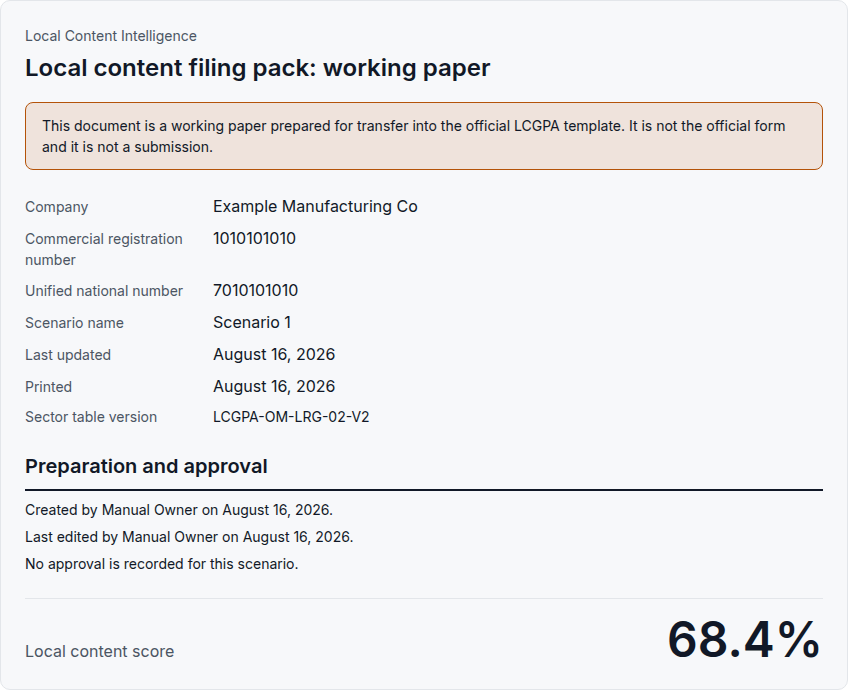
Filing pack
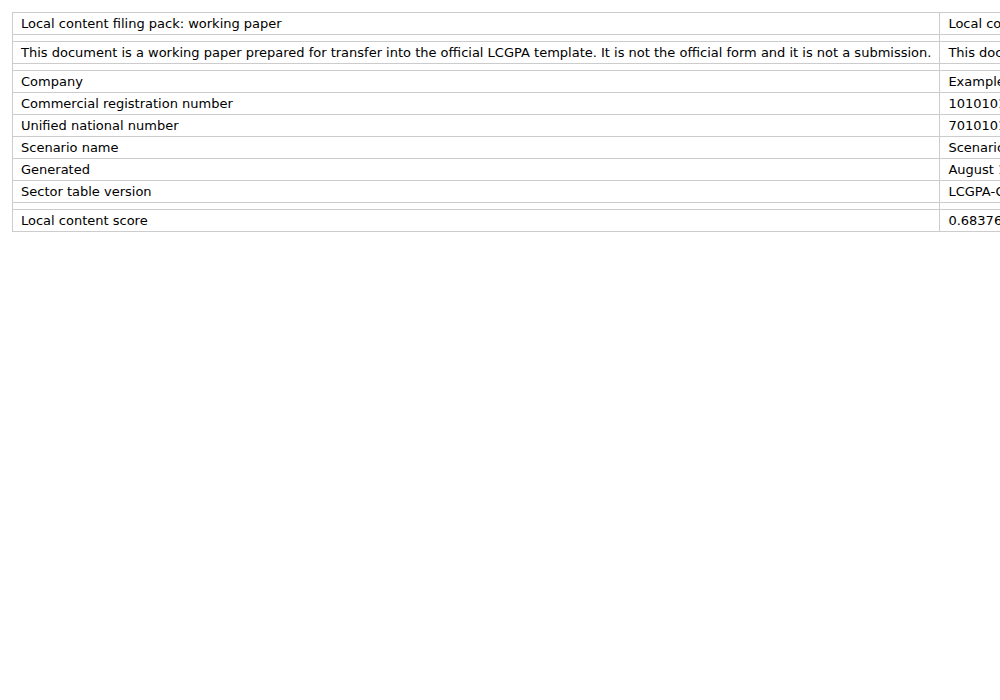
The full working paper as printable pages: every figure, table and verdict.
Excel working paper
The same working paper as an Excel file, downloaded here.
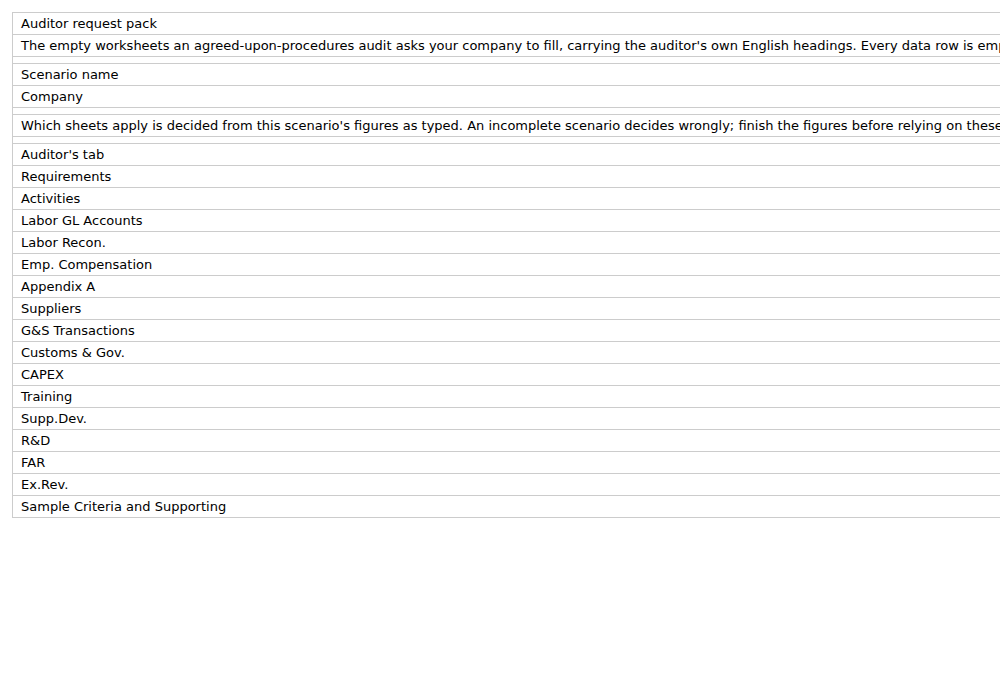
Auditor request pack
The empty worksheets the auditor asks your company to fill, downloaded here.
7. What a Preparer and a Reviewer can do
This grid is read from the product's authorization code at render time: a right that changes there changes here.
Preparer: edits scenarios and filings
Reviewer: reads, approves and sees the audit log
| Field | Preparer | Reviewer |
|---|---|---|
| Open scenarios: the dashboard, the trajectory and the levers. | Yes | Yes |
| Change figures; create, rename, import and delete scenarios; save filings. | Yes | No |
| Record an approval in the audit log. | No | Yes |
| Read the audit log. | Yes | Yes |
| Invite teammates. | Yes | No |
8. What the product does not do
Stated limits, in the product's own words where it states them on screen.
- No table in this product can hold an employee's name, identity number or salary. That is enforced by a test that reads the database's own structure and stops the release if it ever becomes untrue.
- CAPEX score: Computed as if the form's other disallowable (unallocated) costs and unbilled accrued expenses were both zero, figures this product does not store.
- Sector table version: LCGPA-OM-LRG-02-V2
- Scenarios save automatically on this device only. Nothing is sent anywhere.
- The scenario summary, the filing pack, the Excel working paper and the auditor request pack are produced in a workspace, and workspaces are created by invitation.