Know what your filing says before your auditor does.
Local Content Intelligence is software for Saudi supplier companies. It calculates your local content score from your own figures, shows you what the official form will say about it, and produces the working paper your auditor asks for.
Try the calculatorNo account needed. Your figures stay in your browser.
The audit is not the slow part
The agreed-upon-procedures engagement is mandatory and it is not what takes the time. What takes the time is everything before it: pulling supplier spend out of an accounting system one line at a time, matching each supplier to a sector, reconciling the total against audited accounts, and filling in a template that computes its own answers in cells you cannot see.
Most companies do this in a spreadsheet, once a year, under deadline. The section covering goods and services takes the longest, and it takes longer the more transactions you post.
Your figures, the government's arithmetic
Enter your compensation totals, supplier spend, depreciation and capacity building, and the score appears as you type. The calculation follows the official Local Content Score Template exactly, including the parts that are easy to get wrong: the blended supplier rate, the treatment of disallowable costs, which depreciation total the relevant cost is taken from.
Work through the form's sections in order, or use a single screen with every figure on it. Enter suppliers line by line with their sector and audited score, or import them from your own ledger, which is read inside your browser and never uploaded. Your registration details, subsidiaries and headcount are saved once and reused by every filing.
Save several scenarios and compare them. Four levers show the exact point gain from hiring Saudis, moving spend to a listed sector, adding training, or lifting research spend, before you commit to any of it.
Colleagues can join as preparers or reviewers, with an audit log recording who changed what. Everything works in English and Arabic, including what you print and export.
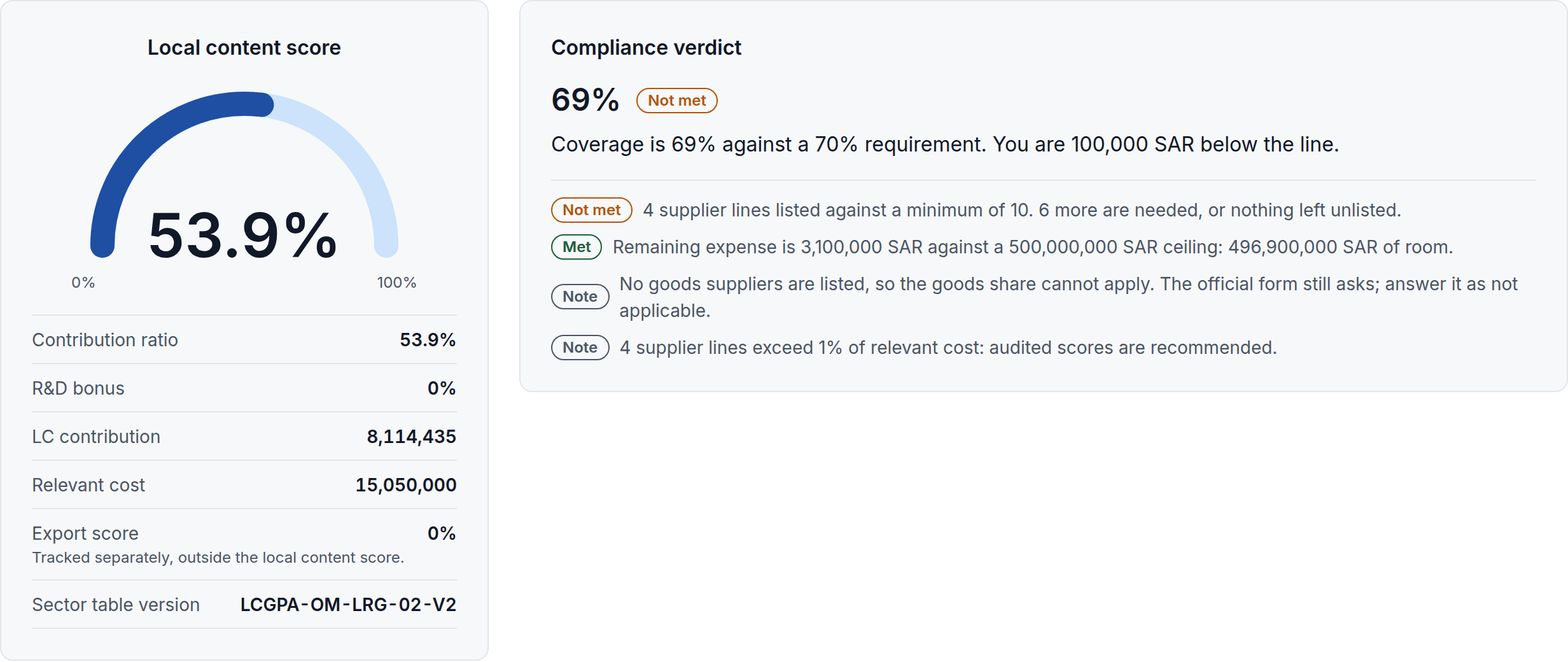
It tells you what is wrong while you can still fix it
The official template checks your filing against several rules and answers each one with a single word. It does not tell you by how much you passed, or how close you came to failing.
This does. Coverage at 69% against a 70% requirement reads as one hundred thousand riyals below the line, not as the word "attention". Appendix A's reconciliation against your audited accounts either balances or names the difference and where to look for it.
We have seen a certified filing that passed its coverage test by around a third of a percentage point. Nobody preparing it by hand had any way of knowing how close it was.
A working paper, not a screenshot
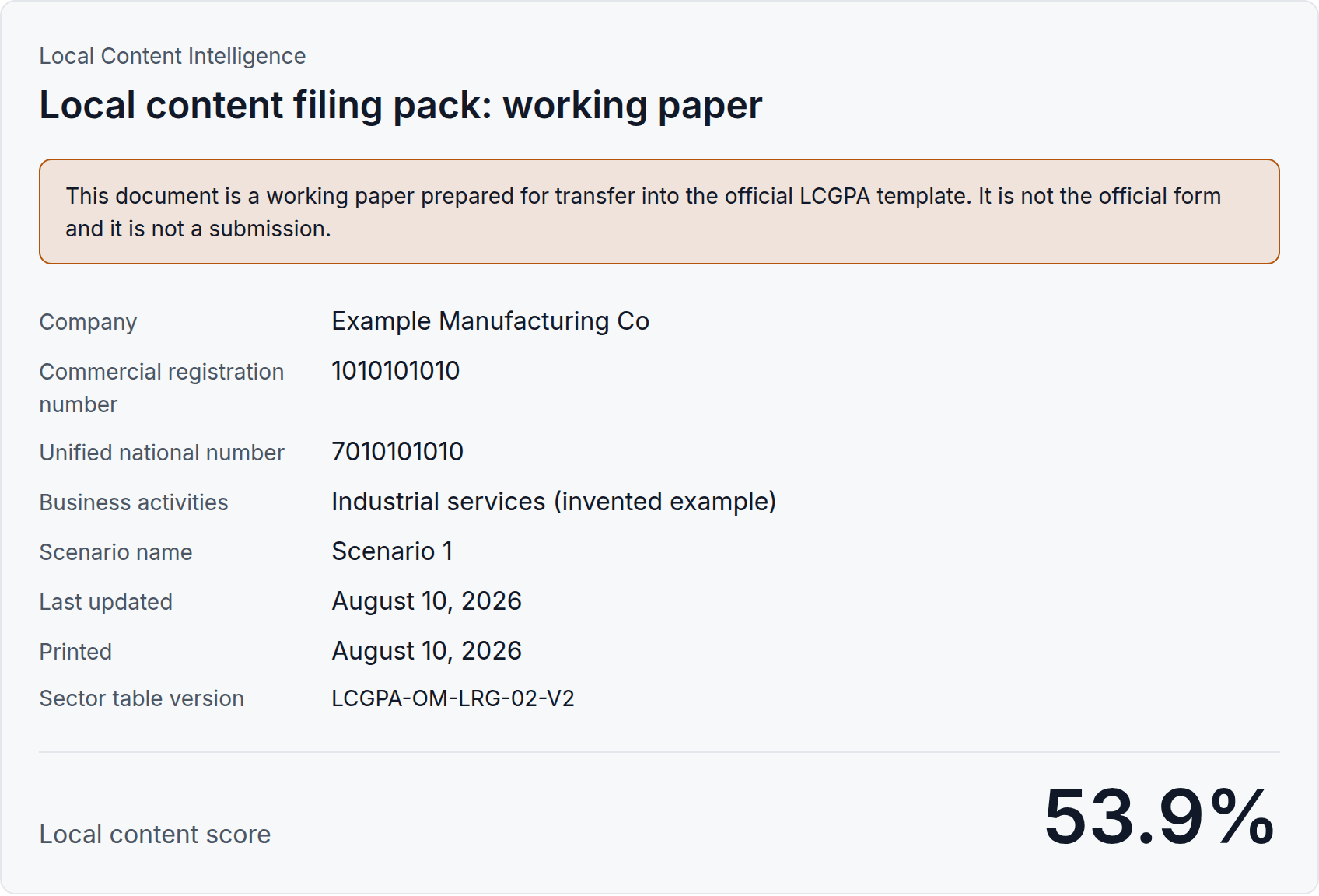
Every workspace scenario produces two documents. A printed filing pack setting out the figures, the supplier breakdown, the compliance checks and the reconciliation to your audited accounts. And an Excel workbook with the same content, sheet by sheet, for anyone who wants to check the arithmetic themselves.
Both carry your company's registration details, both work in English and Arabic, and both are meant to be handed over rather than explained.
Checked against a certified filing
The calculation was built by reading the official template's own formulas rather than by describing them. It reproduces a real certified filing, supplier line by supplier line, to fourteen decimal places, and a test proves it still does before any change reaches this site.
The rules it encodes are named on screen, including which version of the sector table your figures were scored against, so a reviewer can see what was applied rather than trusting that something was.
A certificate that used to be an advantage is becoming something a bid is checked for before the price is read. Since August 2026 a minimum local content percentage on the enterprise certificate decides whether 233 products stay on the mandatory list government buyers must buy from, with more products following in August 2027. From April 2027 local content carries weight in the financial evaluation of government management consulting and information technology tenders of SAR 10 million and above. Management consulting adds a company-level minimum of thirty per cent, and a bid whose certificate falls below it is excluded at technical evaluation. That minimum reaches tenders of SAR 5 million and above in January 2028. Which makes the number worth being sure of.
Nothing about an individual is ever stored
No table in this product can hold an employee's name, identity number or salary. That is enforced by a test that reads the database's own structure and stops the release if it ever becomes untrue.
Files you upload are read inside your browser, and only the totals you approve are sent anywhere. Each company's workspace is invisible to every other at the database layer, not merely in the interface.
Access is by invitation
The calculator is open to anyone: type your figures and the score appears. The compliance verdict, the filing documents, workspaces, saved filings, your team and the audit trail are by invitation. The companies using it now are shaping what it becomes, so it is deliberately a small number.
Ask for access and you will hear back from a person.
Request accessWho you are dealing with
Local Content Intelligence is built and run by Mohammed Shadid. The calculation was developed by reading the official template's own formulas rather than by describing them, against a real certified filing, with the auditor's requirements list in hand.
If a figure looks wrong, if the form asks for something this does not handle, or if it is harder to use than it should be, write and say so. Your message reaches the person who wrote the software, and the reply comes from him rather than from a ticket number.